
ABOUT WHEEL > GENERAL OVERVIEW
What differentiates us from existing wind turbines?
The patented WHEEL technology is an evolved spar concept in the sense that it delivers the required stability by using a large bottom ballast weight which brings the centre of gravity below the centre of buoyancy. If the structure tilts, downward weight on the bottom and upward buoyancy on the top deliver a righting moment that will return the structure to its vertical position (see fig.4).
This concept is of course well known in both oil&gas and offshore wind and is characterized by long vertical structures that will bring the weight down and keep it moving along with the upper buoyancy hull. These long vertical structures are of course the origin of the critical drawbacks that spars face for construction and installation.
One could wonder, could we get rid of such expensive and troublesome structure simply by hanging the lower stabilizing weight from the upper floating hull? Unfortunately, this will not work in general because if the structure tilts, the weight will not move along.
However, that is no longer the case if such suspension is configured with triangularised cables.
The hanging weight keeps the cables in tension, and while in tension they behave as rigid bars. With the right triangularized configuration, they will ensure that the lower ballast weight moves along with the whole system providing the pursued stabilization. This will not only save material but will also bring disruptive opportunities for an industrialized construction and installation process, as will be described next.

Fig. 4
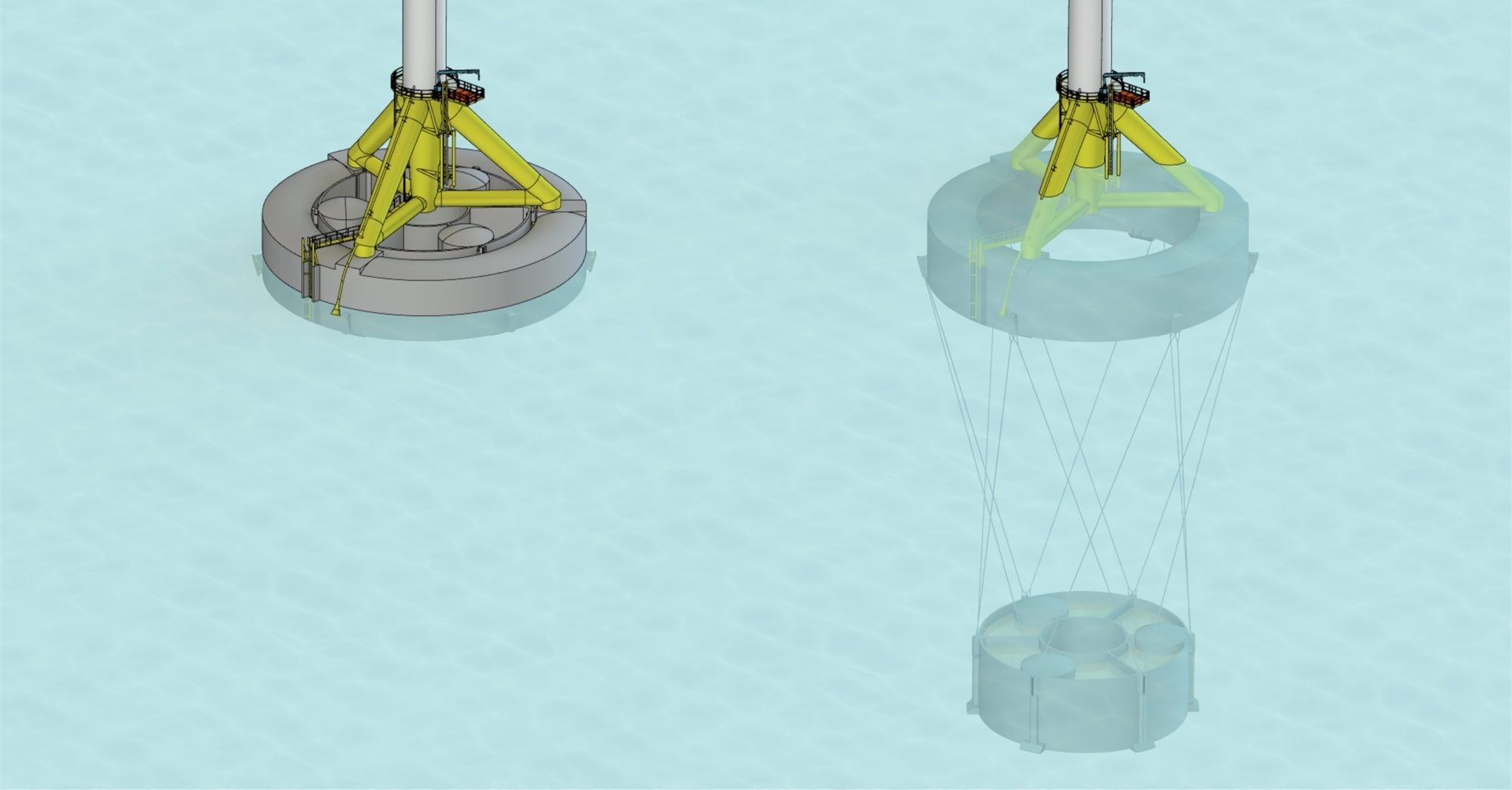
As such, the WHEEL floater comprises an upper tank which provides the required buoyancy and a lower tank which houses the ballast weight. The upper buoyancy tank is conveniently submerged in operation to keep it away from the concentrated wave energy in the surface: fighting the force of the sea with large structures on the surface facing huge storm waves, like semisubs or barges do, is, in our view, probably not the best option. We deem wiser to let the waves pass above you with only a slender transition piece crossing the surface: when facing a 50-year return period storm, you’d rather be in a submarine below the surface than in a ship fighting the waves.
Once sufficiently deep waters are reached, the lower tank can be deployed in a controlled manner and WHEEL will achieve an ultra-stable transparent configuration for operation and survival conditions. Lowering of the ballast tank is performed by regulated water ballasting so lowering speed is adequately controlled; once the lower tank reaches its final position its ballasting shall be completed with solid infill to provide the required ballast weight for operation.
So, what are the main elements of the WHEEL technology?
Triangularised configuration
This makes possible to transmit any force or moment between the Upper Tank and Lower Tank only through variation of the axial force in the cables and with no relevant relative movements between both bodies.
Tendon pretension
It is provided by the Lower Tank submerged weight, which maintains the tendons under tension, so that they will resist axial force variations just as if they were rigid bars and will remain permanently in tension.
Tendon strength and durability
Tendons are based on the highly proven fiber lines commonly used for multiple offshore applications, delivering excellent durability and fatigue strength performance. Tendons used by WHEEL are midsized as compared to other multiple offshore applications.
Overall, WHEEL is excellently suited to allow for significant cost reduction while allowing for simple and effective construction processes which can be industrialized and implemented in a wide range of harbours.

And, what are the main advantages of the WHEEL technology?
It delivers at the same time the key advantages of the two main existing floater concepts: full onshore assembly of the floater and WTG and very low waterplane area in operation.
The WHEEL technology will allow for drastic reduction in the width of the floater as compared to equivalent semisubmersible solutions, which is a major benefit for construction and load-out means and infrastructure.
It will allow for unparalleled reduction in the draft of the floater for inshore operations (harbour and tow-out), which is a key advantage regarding usability and availability of suitable harbours, making it possible to effectively profit from lower cost existing harbour infrastructure and construction means, enhance local production and marine spatial planning, and also ease exportation of this European technology to regions with lower infrastructural development.
Major reduction in carbon footprint due to reduced material usage and local construction strategies minimizing transport related emissions.
Slow motions. Despite its very low material usage it will provide very high mass inertia and thus deliver very high pitch/roll natural periods, far above wave periods, and slow motions, reducing accelerations and forces on the WTG for enhanced production.
Optimized mooring system due to its transparency to wave loading. WHEEL allows for cost-savings in the mooring system as it drastically reduces loads as compared to semisubs. It also allows for the most optimum combination of conventional chains and synthetic ropes, which enchance load management by reducing peak and cyclic loads.
Circular Economy and carbon footprint. The materials, construction and installations methods to be used will allow a substantial reduction of the carbon footprint.
 This Project has been funded by the European Commission under the Horizon Europe program with Grant Agreement number 101084409.
